


01
Taxes
How much of this account is actually yours?
We model your bracket stack year by year — RMDs, Social Security inclusion, IRMAA tiers and the ten-year inherited-IRA window — so the tax bill has a schedule instead of a surprise.
Retirement tax & income architecture
The descent — taxes, required distributions, income sequencing and what your family actually inherits — is where retirements are won or lost. We design that descent from your verified numbers, in writing, with every assumption disclosed.
The descent
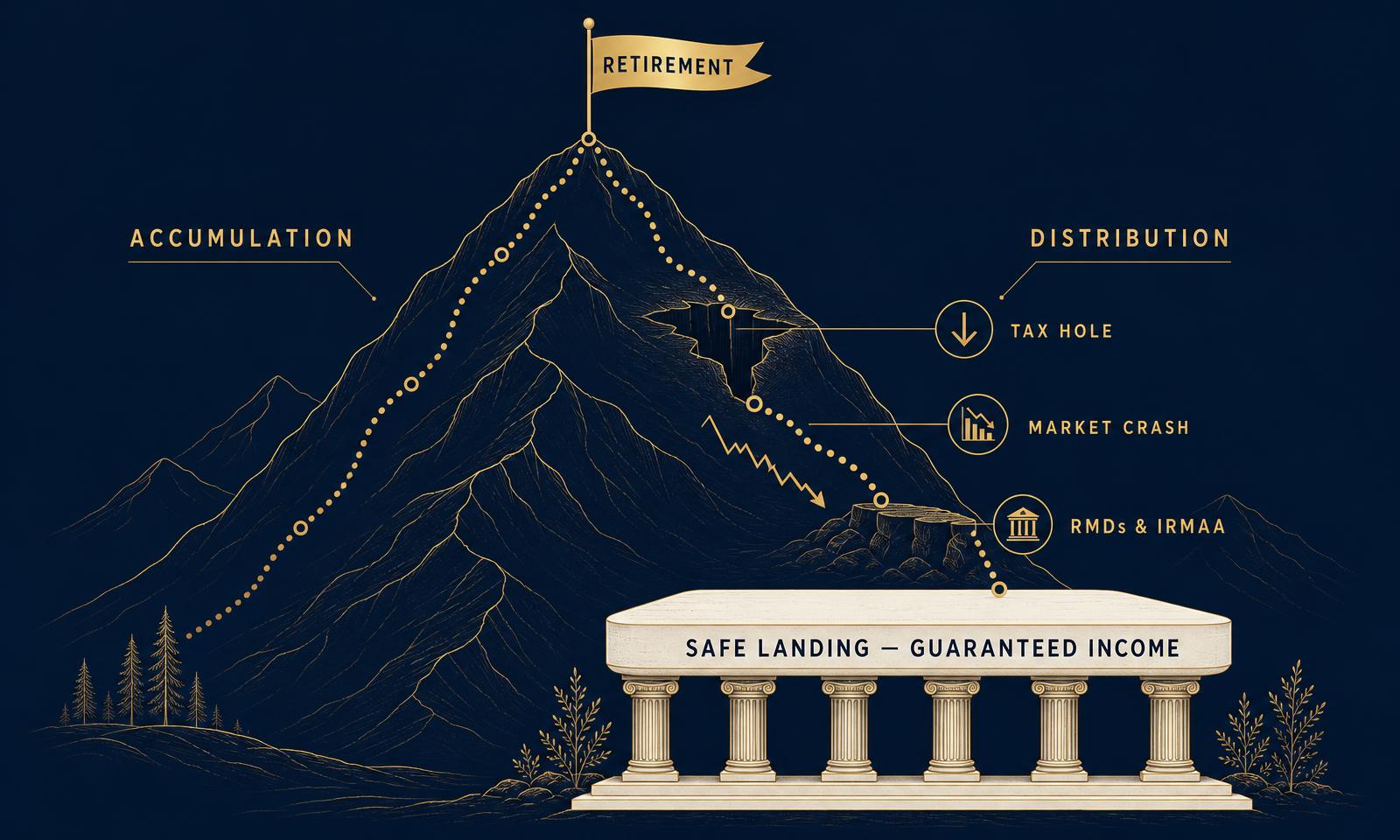
A tax hole opens when required distributions and Social Security stack. A poor sequence of returns in the first decade can permanently reset the plan. The landing has to be supported — by tax-free assets, a defined income floor and, where appropriate, insured guarantees.
The climb
You spent a working lifetime getting up the mountain. You get one attempt at coming down.
Saving rewards patience — decades of contributions, matches and compounding. Distribution rewards precision. The savings phase forgives a mistake; the distribution phase records it. That asymmetry is the entire reason this work exists.
The framework
We answer them in order, with your numbers on the screen. Nothing is recommended until all three are consistent with the criteria you set at the start.
How much of this account is actually yours?
We model your bracket stack year by year — RMDs, Social Security inclusion, IRMAA tiers and the ten-year inherited-IRA window — so the tax bill has a schedule instead of a surprise.

Does the income hold up, net of tax, for as long as you need it?
Essential spending is measured against reliable income first. The gap gets an explicit design, and growth is tested against a poor sequence of returns rather than an average.

What lands in your family's hands, and what lands on their tax return?
Two estates of identical size can differ by hundreds of thousands after tax. We show the after-tax number to your beneficiaries, not the statement balance.
The process
The order matters. Criteria are recorded before options are shown, so the recommendation can be measured against something you wrote down yourself.
“We never ask how to convince a client. We ask what the client said matters, and what the evidence shows.”

A conversation, not a form. What matters, what worries you, and what would have to be true before you would change anything.
Your conditions are written down first — liquidity minimums, spousal income, tax control — and every option is later scored against them.
Your verified numbers run through the conversion, RMD, income floor and legacy engines. Assumptions and calculation detail are one click away.
Investment-centered, protected-income and integrated architecture — each with genuine strengths and genuine trade-offs. No straw men.
A written blueprint with sources, assumptions and the questions to take to your CPA, attorney and investment advisor.
Standards of proof
Our analysis engine runs the full graduated federal bracket table for your filing status, stacks your other income, applies Social Security inclusion rules, the current Uniform Lifetime Table and published IRMAA tiers — not a flat assumed rate.

Who this is built for
Most people don't arrive worried about brackets. They arrive worried about whether the money lasts, whether one of them is left managing it alone, and whether the children inherit a gift or a tax bill. Those are the questions the arithmetic answers.

Ages 55–72, most of the net worth inside an IRA or 401(k), and a conversion window that closes the moment RMDs and Social Security start stacking.
Income needs to start, the portfolio has to survive a bad first decade, and every withdrawal decision is also a tax decision.
The money will outlive the plan. The question is which generation pays the tax, and at whose bracket.
Walked through, not handed over
Every blueprint is presented live — in person or on screen — with the assumptions visible and editable. Change the conversion amount, the retirement date, the return sequence, and watch the tax, income and legacy numbers move in front of you. Nothing is presented as certain that we cannot recalculate on the spot.
Questions we're asked first
